Traumatic Stress and the Brain
Trauma doesn't just live in memory, it reshapes how your brain actually works. Understanding
those changes can bring clarity to feelings that otherwise seem confusing, and it opens a real
path toward healing. This isn't about being "broken." Your brain adapted to protect you. In
trauma therapy, our goal is to help it learn, gently, that it's safe to relax again.
Meet Your Brain's Alarm System
Three parts of the brain matter most when we talk about trauma: the amygdala, the
hippocampus, and the prefrontal cortex.
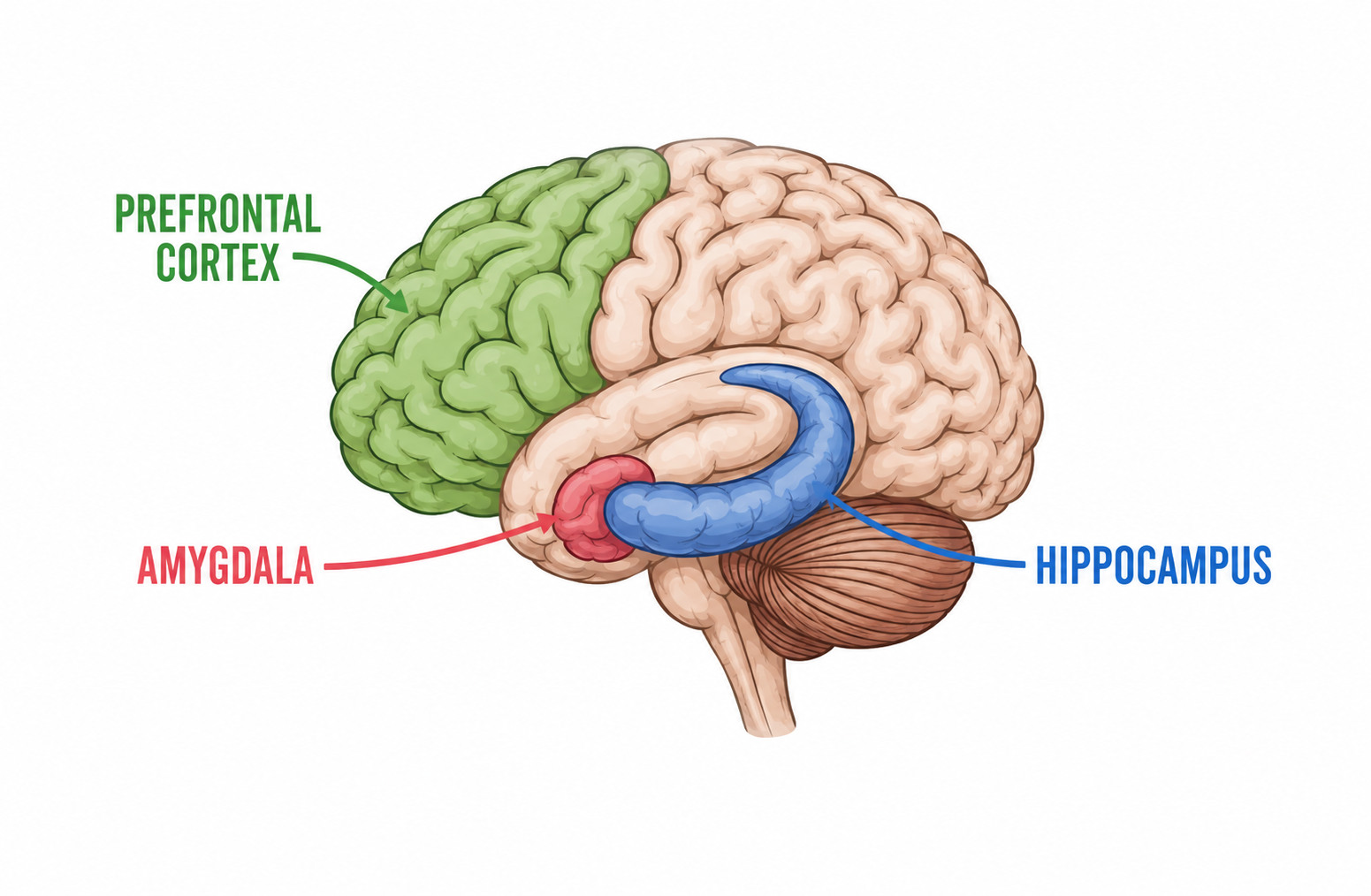
Think of the amygdala as your brain's smoke alarm. Its job is to spot danger and sound the
alarm faster than you can even think. After trauma,
that alarm can get too sensitive. It might go
off over things that aren't actually dangerous, like a loud noise or a crowded room. That's not
you overreacting. That's your brain working overtime to keep you safe.
The hippocampus works more like a filing cabinet for memories. Normally, it stamps each
memory with a time and place, so your brain knows, "that happened back then, not now." But
stress hormones can shrink this part of the brain over time, and when that happens, memories
don't get filed away the way they should. Instead of staying in the past, they can feel like they're
happening all over again. That's a big part of why flashbacks happen.
Then there's the prefrontal cortex. It's what helps you stay calm, make decisions, and keep
impulses in check. When you're scared, this part actually quiets down so your alarm system can
take the wheel. In real danger, that's a good thing. But after trauma, it can get stuck, making it
hard to think clearly or feel calm even when you're actually safe.
Fight, Flight, Freeze, or Fawn
You've probably heard of "fight or flight." But if you've ever frozen up in a scary moment, or
found yourself trying to please someone who felt threatening, you've experienced two other
equally common responses: freeze and fawn. When your brain senses a threat — real or
perceived — it releases stress hormones like adrenaline and cortisol, and your body shifts into
survival mode almost instantly, often before you're consciously aware of what's happening.
The four most common trauma responses are: fight, flight, freeze, and fawn.

Fight — Fight is your body's attempt to face the threat head-on. It can show up as anger, a tight jaw, or an urge to yell or push back. In the moment, fighting can feel empowering, this is your body trying to overpower the danger.
Flight — Flight is the urge to escape. Your body floods with energy meant to help you run, avoid, or get away from what feels dangerous. This can look like literally leaving a room, or more subtly, avoiding certain people, conversations, or situations altogether.
Freeze — Freeze happens when fighting or fleeing doesn't feel possible. Your body essentially hits pause. You may feel stuck, unable to move or speak, foggy, or disconnected from what's happening around you. This response is often misunderstood; people sometimes blame themselves for "not fighting back," without realizing their nervous system made that choice for them, automatically.
Fawn — Fawn is the response of trying to please, appease, or accommodate a threat to make it go away. It often shows up as people-pleasing, over-apologizing, or prioritizing someone else's comfort over your own needs and safety.
All four responses exist because, at some point, they worked — at least partially. The problem is
that these patterns can become automatic long after the original danger is gone. A response
that once protected you in a genuinely threatening situation can get triggered by things that
aren't actually dangerous now, a raised voice, conflict, or even just uncertainty. This isn't a
character flaw. It's a nervous system doing what once kept you safe.
The Window of Tolerance
Here's a simple way to picture how this all fits together. Therapists call it the Window of
Tolerance. Think of it as a "calm zone" where you can think clearly, feel your emotions without
being overwhelmed, and connect with people around you.
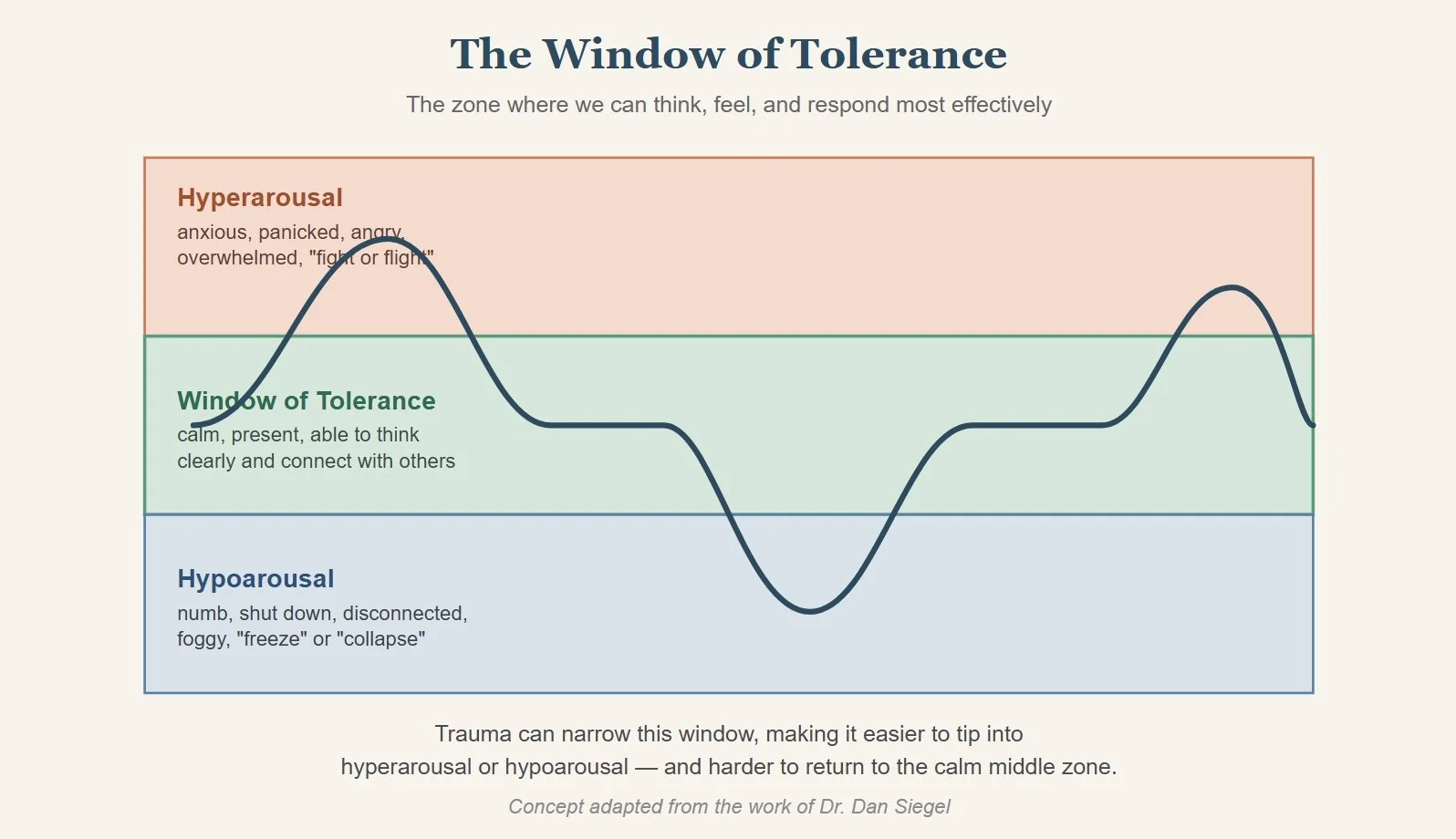
Trauma tends to shrink that zone. It becomes easier to swing into Hyperarousal or hypoarousal.
Fight and flight are both examples of hyperarousal — your nervous system revving up past that
window, flooding you with energy and urgency. Freeze, and often fawn, tend to reflect
hypoarousal — your nervous system dropping below the window into shutdown, numbness, or
a drive to make yourself small and safe by pleasing others. The four trauma responses are
really just different directions that your nervous system can be pushed outside its window when
a threat feels too big to handle from the calm middle. The wider and more flexible the window of t
olerance becomes, the easier it is to stay grounded.
A big part of therapy is helping to widen that calm zone again by helping your nervous system
build more flexibility, so that over time, it's easier to recognize actual safety and return to a calmer, more regulated state.
The Good News: Your Brain Can Change
Here's what matters most: the brain is not stuck this way forever. This ability to change is
called neuroplasticity, and it's the reason therapy works. Just like your brain adapted to protect
you after trauma, it can adapt again with the right kind of support. Safe relationships and proven
therapies, like EMDR, somatic therapy, CPT, and trauma-focused CBT, can help:
● Calm down an overactive alarm system (amygdala)
● Help memories get properly filed away (hippocampus)
● Strengthen your ability to think clearly and stay calm (prefrontal cortex)
This kind of healing takes time, and it isn't always a straight line. But it is possible. The same
brain that changed because of trauma can change again toward healing.
A Note for You
If any of this sounds familiar, please know: these reactions are not a flaw. They're a brain and
body that worked hard to keep you safe. With the right support, your brain can learn that you're
safe now, too. If you're dealing with the effects of trauma, working with a trauma-informed
therapist is one of the best steps you can take.
This post is for general education and isn't a substitute for individual care. If you're in crisis or
having thoughts of self-harm, please call or text 988 (Suicide & Crisis Lifeline) or contact your local emergency services.
Sources
1. "Volumetric Analysis of Amygdala, Hippocampus, and Prefrontal Cortex in
Therapy-Naive PTSD Participants." National Library of Medicine, PMC (2014).
https://www.ncbi.nlm.nih.gov/pmc/articles/PMC3972941/
2. "Neuroimaging Correlates of Resilience to Traumatic Events — A Comprehensive
Review." National Library of Medicine, PMC (2019).
https://www.ncbi.nlm.nih.gov/pmc/articles/PMC6315158/
3. Fitzgerald, J. M., et al. "Prefrontal cortex, amygdala, and threat processing: implications
for PTSD." Neuropsychopharmacology (2021).
https://www.nature.com/articles/s41386-021-01155-7
4. Siegel, D. J. The Developing Mind: How Relationships and the Brain Interact to Shape
Who We Are. Guilford Press, 1999. (Origin of the "window of tolerance" concept.)
5. Walker, P. Complex PTSD: From Surviving to Thriving. Azure Coyote Publishing, 2013.
(Origin of the "fawn" response as a fourth trauma reaction alongside fight, flight, and
freeze.)
6. "The Roles Neuroplasticity and EMDR Play in Healing from Childhood Trauma." Psych
Central (2022).
https://psychcentral.com/ptsd/the-roles-neuroplasticity-and-emdr-play-in-healing-from-chi
ldhood-trauma
7. "How PTSD Affects the Brain." Brainline.org (2019).