When Your body is Fighting a Battle, Your Mind Feels it too.
Do you ever feel like you're grieving a body you used to have?
Do you find yourself apologizing — again — for canceling plans, for moving slower, for needing to sit down?
Do you wonder why "just stay positive" feels like one more thing on a very long to-do list?
Do you sometimes feel like you have to perform wellness for other people, even on the days you feel worst?
If any of this sounds familiar, you're not imagining the connection between your physical health and your mental health. It's real, it's well-documented, and it's not a sign that you're handling things wrong.
The Two Aren't Separate — They Never Were
We tend to talk about "physical health" and "mental health" like they live in different rooms of the same house. They don't. They share the same walls, the same plumbing, the same foundation.
When a body is managing pain, fatigue, inflammation, or the daily unpredictability of a chronic condition, the nervous system doesn't get a day off. It's on alert. That's not weakness. That's your body doing its job under harder conditions than most people ever have to think about.
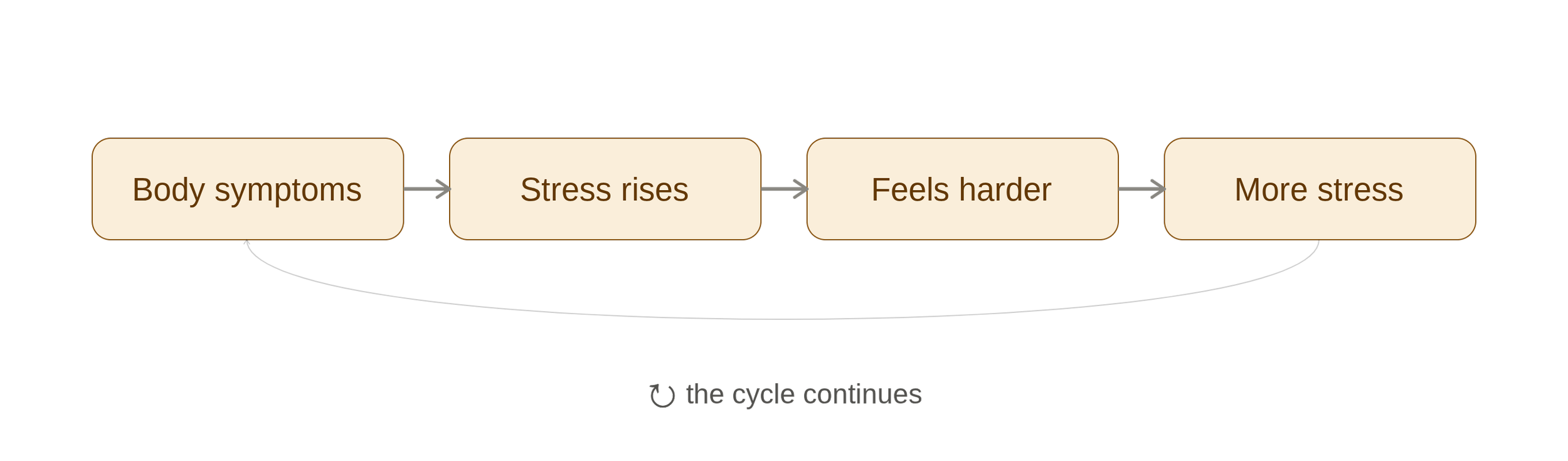
This is why treating a chronic illness as "just physical" so often falls short. The body and the mind are reading the same signals, running on the same sleep, and drawing from the same limited energy each day. When one struggles, the other feels the strain. That's not a coincidence. That's how bodies work.
Why This Happens:
The stress response doesn't know the difference between a tiger and a test result. Your amygdala — think of it as your brain's smoke alarm — reacts to chronic pain or scary diagnoses the same way it reacts to danger. It goes off, and it can stay going off for years if the underlying threat (your illness) never fully resolves. That's exhausting, and it's not a character flaw. It's a smoke alarm doing overtime.
Grief shows up even when no one has died. Losing the ability to do things you used to do — a career, a hobby, spontaneity — is a real loss. Grief is a normal response to real loss, not an overreaction.
Uncertainty is its own kind of exhausting.Not knowing when the next flare will hit, or whether a treatment will work, keeps the nervous system in a state of bracing. That bracing has a name: anticipatory anxiety. It isn't you being dramatic. It's a rational response to genuine unpredictability.
Isolation compounds everything. Chronic illness often means canceled plans, misunderstood limitations, and friends who quietly drift. Isolation and depression feed each other — and neither one means you did anything wrong.
Being disbelieved leaves a mark.If doctors, family, or coworkers have ever questioned whether your symptoms were "really that bad," your nervous system learned something from that — that it isn't safe to trust your own signals, or that you have to prove your pain to be taken seriously. That kind of doubt is its own quiet injury, and healing from it is part of this work too.
Common Ways This Can Show Up
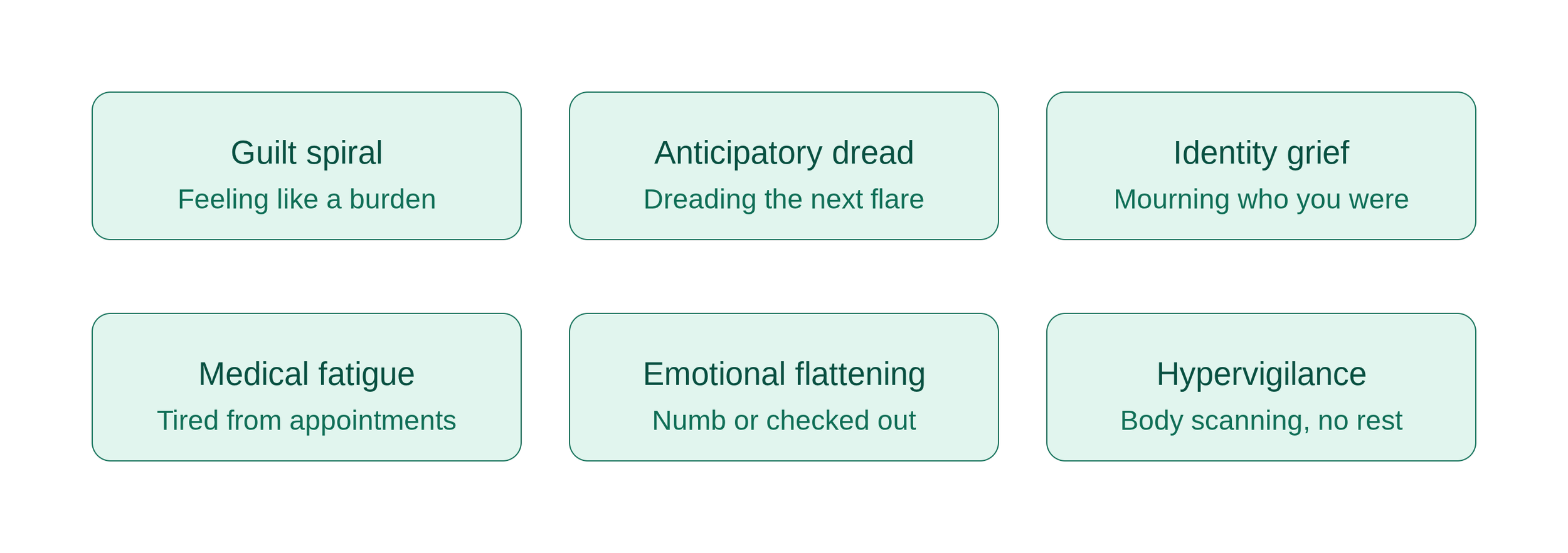
None of these are signs you're failing at having a chronic illness. There's no gold medal for coping perfectly, and there's no wrong way to feel about a body that's asking more of you than it used to.
What Actually Helps
Healing here doesn't mean "fixing" your body first and your mind second. It means treating both as connected, ongoing work.
Naming what you feel, without judging it."I'm exhausted and grieving" is more accurate — and more useful — than "I should be handling this better."
Finding a provider who treats the whole picture.Integrated care, where physical and mental health providers actually talk to each other, tends to lead to better outcomes than treating them separately.
Connecting with others who get it. Chronic illness support communities — in person or online — can ease the isolation that makes everything heavier.
Small, sustainable routines over big overhauls. Gentle movement, consistent sleep windows, and pacing yourself matter more than any single "wellness fix."
Letting go of the "productive patient" pressure. You don't owe anyone a positive attitude, a tidy recovery story, or constant gratitude for surviving something hard.
Building in rest before you're depleted, not just after. Pacing isn't giving up — it's protecting the energy you have so it lasts longer.
This isn't a straight line. Some days will feel like progress, and some days will feel like the beginning again. Both are part of the same process, not evidence that it isn't working. Setbacks don't erase the progress that came before them.
A Note for You:
If you're living with a chronic condition and finding your mental health is struggling too, that's not a personal failure. It's a well-documented, common response to a genuinely hard situation. Healing isn't about eliminating every hard day — it's about building a life, and a body, you can keep living in, one day at a time. That takes time. It isn't a straight line. But it is possible.
This post is for general education and isn't a substitute for individual care. If you're in crisis or
having thoughts of self-harm, please call or text 988 (Suicide & Crisis Lifeline) or contact your local emergency services.
Sources
Aaron, R.V., et al. (2025). Prevalence of Depression and Anxiety Among Adults With Chronic Pain: A Systematic Review and Meta-Analysis. JAMA Network Open. Found that roughly 40% of adults with chronic pain experience clinically significant depression and anxiety. pubmed.ncbi.nlm.nih.gov/40053352
PLOS One (2025). Frequency and predictors of depression and anxiety in chronic illnesses: A multi-disease study. Found depression rates of 31% and anxiety rates of 13.25% among people with chronic disease, compared to 11% and 6% in healthy controls. journals.plos.org/plosone
Middle East Current Psychiatry (2023). Prevalence and correlates of stress, anxiety, and depression in patients with chronic diseases. Found stress, anxiety, and depression prevalence of 68.7%, 51.1%, and 58.8% respectively among people with chronic conditions like cardiovascular disease, cancer, and chronic kidney disease. mecp.springeropen.com
PMC (2025). Prevalence of Anxiety and Depression Symptoms Among Patients With Inflammatory Bowel Disease. A meta-analysis of over 158,000 participants found about 35% of IBD patients experience anxiety symptoms and 22% experience depression symptoms. pmc.ncbi.nlm.nih.gov/articles/PMC12415347
Support and further reading:
National Alliance on Mental Illness (NAMI): nami.org
Chronic Disease Coalition: chronicdiseasecoalition.org
Global Healthy Living Foundation (chronic illness community support): ghlf.org