Coming Back to Center
Living With Hypervigilance and Dissociation
If you've ever felt your whole body snap to attention at a sound that turned out to be nothing, or found yourself staring at a wall with no idea how ten minutes passed, you've met two of the nervous system's most misunderstood survival strategies: hypervigilance and dissociation. They can feel like they belong to entirely different people — one wired and watchful, the other foggy and far away. But they sit on the same spectrum and understanding that connection is often the first real relief.
What is hypervigilance?
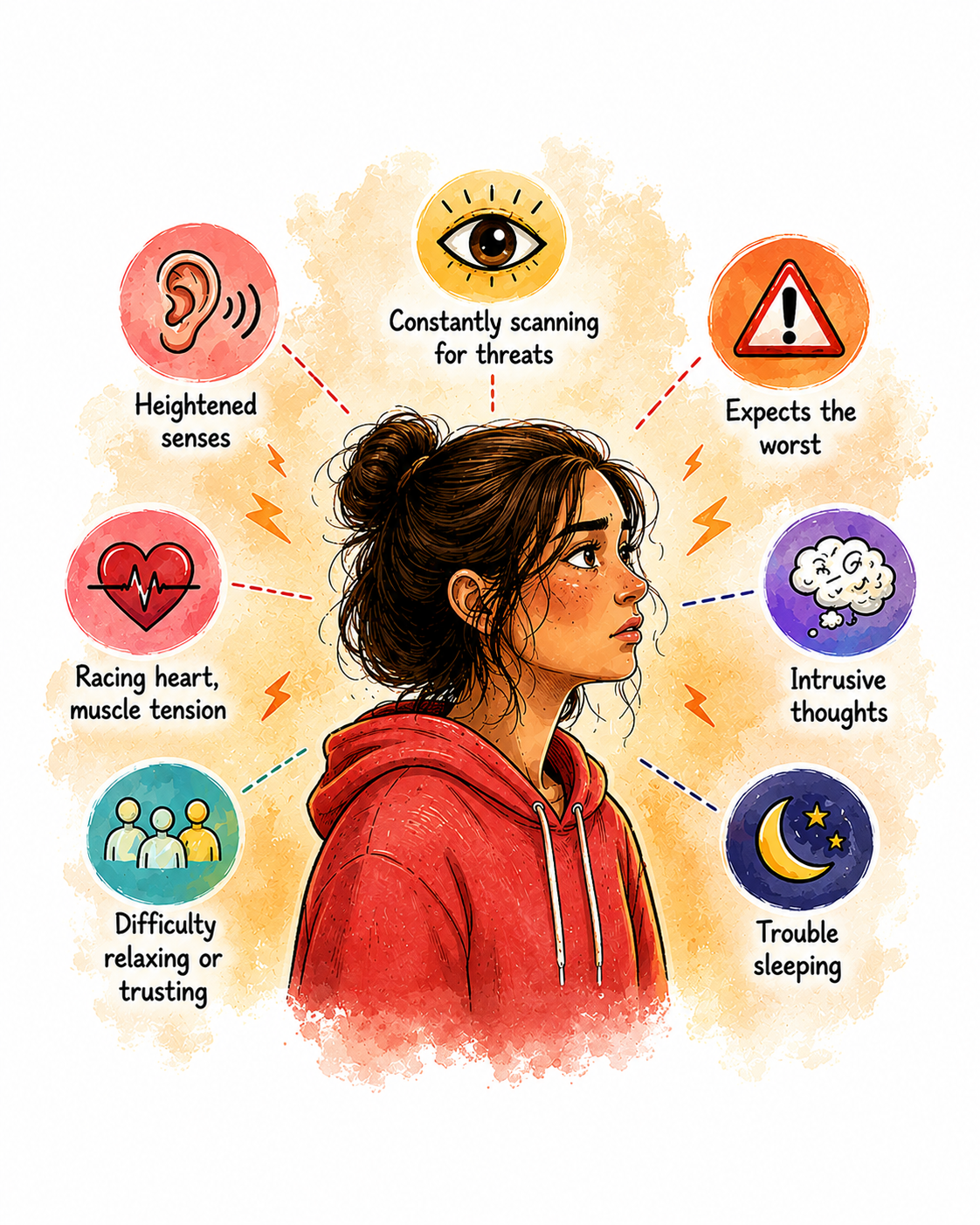
Hypervigilance is a state of heightened sensory sensitivity and constant scanning for danger, even in objectively safe environments. You might notice it as a racing heart, eyes that keep darting around a room, or a startle response that feels way bigger than whatever triggered it.
Conversations can become hard to follow and no matter how hard you try you just can’t seem to focus your attention. It often creeps into sleep, leaving you lying awake with a sense that something bad is about to happen. Left unaddressed, it can begin showing up in the body as chronic fatigue, headaches, or digestive trouble.
Is hypervigilance a symptom of trauma?
Yes. It's one of the hallmark hyperarousal symptoms of PTSD, but it also shows up with anxiety disorders, complex trauma, and sometimes on its own after a period of chronic stress.
Think of the brain as having a smoke alarm (the amygdala) and a calm, level-headed adult in the room (the prefrontal cortex) whose job it is to check if there's an actual fire before everyone panics. In PTSD, research shows that the smoke alarm pays extra-close attention to physical feelings like a racing heart or a tight chest, and treats them as proof that something's wrong. At the same time, the calm adult in the room struggles to speak up and say "it's fine, that was just a door." So the alarm doesn't get talked down, it just keeps ringing, and the whole system stays stuck feeling like something's wrong.
What is dissociation?
Dissociation is the nervous system's other survival strategy: disconnection. Instead of gearing up to fight or flee, the body pulls the plug; going numb, checking out, or making things feel unreal, almost like watching your life through glass instead of living inside it.

If a feeling or a memory was too overwhelming to process at the time it happened, the mind found a way to survive it anyway: by turning down the volume, blurring the edges, or stepping just far enough outside the moment that it became bearable.
It helps to think of dissociation as a dial, not a single fixed experience. On the mild end, it might just look like losing track of time while scrolling your phone, or driving a familiar route and not remembering the drive. Further along the dial, it can feel like watching yourself from outside your own body, or like the room around you has gone slightly fake or far away. Dissociation is essentially the body's attempt to shield you from feeling something that once felt like too much to handle in the moment.
Dissociation doesn't always look the same from person to person, or even moment to moment. Sometimes it shows up as emotional flatness, a sense of going through the motions without really feeling anything, good or bad. Sometimes it's more sensory: colors seem duller, sounds seem farther away, or your own hands look unfamiliar when you look down at them. Other times it shows up as gaps, losing chunks of a conversation, forgetting how you got somewhere, or realizing you've been staring at the same paragraph for ten minutes without absorbing a word of it.
None of these are signs of something being "wrong" with a person; they're signs of a nervous system that once had to protect itself, still reaching for a familiar exit.
The thread that connects them: your nervous system's three states
There's a helpful way to think about why these two very different experiences are connected, based on the work of neuroscientist Stephen Porges, called the Polyvagal Theory. Picture your nervous system as a dimmer switch with three settings: Calm and connected, On alert, and Shut down.
The "calm and connected" setting, which Porges calls the ventral vagal state, is where the nervous system feels safe enough to rest, engage with others, and think flexibly. It's the state we're built to spend most of our time in. But when the nervous system detects a threat, whether that threat is real or just resembles something dangerous from the past, it drops out of that state and reaches for one of two backup plans. The first is "on alert," the sympathetic fight-or-flight response: heart racing, senses sharpened, body mobilized to handle danger. If that doesn't resolve the threat, the system can drop even further into "shut down," the dorsal vagal response: the body's last-resort setting, built for situations where fighting or fleeing isn't possible.
After trauma, that dimmer switch can get stuck closer to "on alert" or "shut down," and it starts misreading harmless, everyday moments as dangerous. A raised voice, a certain look, even silence can flip the switch, not because the danger is real right now, but because the nervous system is pattern-matching against something old.
How therapy can help
If the nervous system got stuck through repeated experience, it makes sense that it also heals through repeated experience, just of a different kind. Therapy isn't about convincing the nervous system that hypervigilance or dissociation aren't necessary. Instead, it works by giving the nervous system new, safer experiences over and over, until "calm and connected" starts to feel like a place it can actually stay.
A few ways this tends to happen:
Co-regulation. Before someone can regulate their own nervous system, they often need to borrow someone else's steadiness for a while. A therapist's calm presence, paced breathing, and steady voice can act like a tuning fork, gently inviting an anxious or shut-down nervous system back toward center. Over time, the body starts learning what safety actually feels like, sometimes for the first time.
Widening the window from the inside out. Good trauma-informed therapy doesn't push someone straight into their hardest material. It works at the edges of the window of tolerance, just enough activation to build capacity, not so much that the system tips into fight, flight, or shutdown. This is often why pacing matters so much in trauma work; going too fast can just reinforce the very edges therapy is trying to soften.
Naming what's happening in the moment. Simply learning to recognize "I'm on alert right now" or "I'm starting to check out" gives someone a foothold. It shifts the experience from something that just happens to them into something they can notice, and eventually, something they have some say in.
Body-based approaches. Because these states live in the nervous system and not just in thought, talk therapy alone doesn't always reach them. Approaches like somatic experiencing, EMDR, sensorimotor psychotherapy, or even simple grounding and breathing practices work directly with the body, helping it complete the survival responses that got interrupted or stuck, and discharge some of that old activation.
None of this means someone will never feel hypervigilant or dissociated again. It means those states stop being the only settings the dial knows how to find.
When to reach out for more support
Self-directed strategies genuinely help, but hypervigilance and dissociation that are frequent, intense, or interfering with daily life are worth bringing to a therapist, ideally one experienced in trauma-focused care (CPT, CBT, EMDR, or somatic approaches). If dissociation includes memory gaps you can't account for, or you're ever concerned about your safety, that's a signal to get support sooner rather than later, not a sign you're failing at managing this on your own.
Sources
SimplyPsychology — What Is Hypervigilance? A Core Symptom of PTSD
Cleveland Clinic — Always on Alert: Causes and Examples of Hypervigilance
Good Health Psych — Hypervigilance in PTSD: Signs, Symptoms & Coping Tips
PTSD UK — Hypervigilance and PTSD
Polyvagal Institute — What is Polyvagal Theory?
IPTrauma / Psychotraumatology — Polyvagal Theory
Psychology Today — Polyvagal Theory: An Approach to Understanding Trauma